Community pharmacy represents the most accessible node of health-care delivery across the globe. Traditionally centered on the compounding & dispensing of medicinal products, the profession has undergone a paradigm shift over the past half-century. Globally particularly in high-income countries, community pharmacy has transformed into a patient-centered, clinical, and preventive healthcare discipline. Modern community pharmacists act as medication therapy managers, public health advocates, point-of-care diagnosticians, and immunizers.
In contrast, community pharmacy practice in India remains primarily commercial and product-focused, though it is currently on the cusp of significant regulatory and structural evolution. Historically, Indian pharmacy practice originated during the colonial era as an unregulated, trader-driven trade where untrained clinic assistants, known as “compounders,” prepared and dispensed formulations under medical supervision. The Pharmacy Act of 1948 and the Drugs and Cosmetics Act of 1940 sought to standardize education and licensing. However, systemic challenges—such as a dual-tier educational system, variable enforcement across states, and a commercial mindset—have delayed the integration of advanced clinical standards.
Global Benchmarks in Community Pharmacy Practice
nternational practice standards, codified by bodies such as the International Pharmaceutical Federation (FIP) and the World Health Organization (WHO), emphasize the Good Pharmacy Practice (GPP) framework. Developed nations have integrated these principles into statutory mandates and national health services.
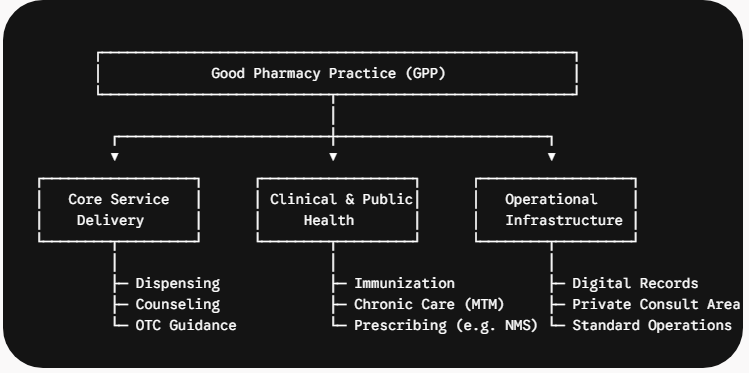
Key Global Practice Pillars:
- Medication Therapy Management (MTM) & Chronic Care:
- United Kingdom (NHS): Services like the New Medicine Service (NMS) and Structured Medication Reviews allow pharmacists to counsel patients starting new chronic disease regimens and evaluate polypharmacy.
- United States & Canada: Pharmacists perform comprehensive medication reviews (CMRs), identify drug-therapy problems, and modify therapy under Collaborative Practice Agreements (CPAs).
- Expanded Scope of Practice & Prescribing Rights:
- United Kingdom: Independent Prescribing (IP) qualifications allow pharmacists to diagnose and prescribe medications autonomously within their competence.
- Canada, Australia, & New Zealand: Pharmacists prescribe for minor ailments, renew long-term prescriptions, and substitute therapeutic equivalents.Strategic Roadmap for Harmonization
- To align Indian community pharmacy practice with international benchmarks, a multi-phased strategy across regulation, education, and practice infrastructure is essential:
- Regulatory Reform
- Enforce Pharmacy Practice Regulations (PPR 2015): Mandate physical pharmacist attendance and penalize license-renting.
- Define a Clear OTC Policy: Establish an official Over-the-Counter (OTC) drug list separating self-care products from strict prescription-only medications.
- Authorize Minor Ailment Protocols: Allow trained community pharmacists to evaluate and manage minor conditions (e.g., uncomplicated UTIs, allergic rhinitis, simple dermatological issues) using structured treatment protocols.
- Educational Upgradation
- Modernize the D.Pharm & B.Pharm Curricula: Shift coursework toward clinical pharmacology, patient counseling, communication skills, and digital health tools.
- Mandatory Continuing Professional Development : Require re-certification every 3 to 5 years tied to verified CPD credits.
- Infrastructure & Technology Integration
- Redesign Spatial Layouts: Require a minimum enclosed area for private patient counseling in both independent and chain pharmacies.
- Standardize Point-of-Care Diagnostics: Establish clear clinical guidelines for pharmacies providing basic health monitoring (e.g., blood glucose, blood pressure, lipid profiles).
- Adopt Electronic Health Integration: Connect retail point-of-sale systems with public health databases to track antibiotic consumption and support pharmacovigilance reporting.
- Immunization and Public Health Services:
- In over 40 countries, community pharmacists are primary providers of routine adult and pediatric immunizations (e.g., Influenza, COVID-19, Pneumococcal, Shingles).
- Pharmacists conduct point-of-care screening (blood pressure, HbA1c, lipid profiles) and lead harm-reduction programs (needle exchanges, opioid antagonist dispensing).
- Digital Health & Interoperability:
- Direct access to Electronic Health Records (EHR) enables pharmacists to view lab results, diagnostic histories, and physician notes, ensuring clinical safety during dispensing.
Comparative: Global vs. Indian Scenario
| Dimension | Global Standard (US, UK, EU, Australia) | Indian Scenario (Current Status) | Gap Analysis & Impact |
| Primary Focus | Patient-centered outcome optimization, clinical care, public health. | Product dispensing, commercial sales, transaction fulfillment. | Indian model emphasizes inventory velocity over clinical interventions. |
| Minimum Education | PharmD (US), MPharm (UK), or BPharm (4-year honors + 1-year residency). | Diploma in Pharmacy (D.Pharm – 2 years) or Bachelor of Pharmacy (B.Pharm – 4 years). | D.Pharm curriculum focuses heavily on basic science rather than advanced clinical care. |
| Prescribing Rights | Independent Prescriber, Supplementary Prescriber, Collaborative Practice. | Strictly prohibited; dispensing must follow a registered practitioner’s prescription. | Absence of minor ailment schemes increases burden on primary care physicians. |
| Patient Counseling | Statutory mandate; requires private consultation spaces and documented sessions. | Voluntary and rare; driven by store traffic and commercial constraints. | Low counseling rates contribute to non-adherence and adverse drug events. |
| Immunization | Widespread authorization for adult and pediatric vaccinations. | Not authorized in retail settings; restricted to hospital/public health channels. | Underutilized infrastructure for expanding national vaccine coverage. |
| Facility Requirements | Minimum floor space, segregated dispensing, mandatory private counseling rooms. | Schedule N regulations specify basic space, but enforcement varies widely across states. | Lack of private spaces impedes confidential patient interactions. |
| Digital Integration | Full EHR interoperability, electronic prescriptions (e.g., NHS EPS). | Fragmented; rising e-prescriptions in chains, but paper prescriptions dominate. | Paper workflows increase risks of transcription errors and drug interactions. |
In-Depth Analysis of the Indian Scenario
Community pharmacy in India operates under a dual-regulatory mandate:
The Drugs and Cosmetics Act, 1940 & Rules, 1945:
Regulates the manufacture, sale, and distribution of drugs. Schedule M defines manufacturing standards, while Schedule N sets operational guidelines for retail pharmacies detailing minimum equipment, space, and storage requirements. Schedule H, H1, and X government prescription-only sales and habit-forming drugs.
The Pharmacy Act, 1948:
Established the Pharmacy Council of India (PCI) and State Pharmacy Councils to regulate educational qualifications and professional registration.
Pharmacy Practice Regulations (PPR) 2015:
Promulgated by the PCI to standardize hospital and community pharmacy practice, formalizing roles such as patient counseling, drug interaction monitoring, and adverse drug event reporting. However, statutory enforcement by state drug controllers remains inconsistent.
Educational Dichotomy: D.Pharma vs. B.Pharma vs. PharmD
India features a multi-tiered educational entry model:
- Diploma in Pharmacy (D.Pharma): A 2-year vocational program traditionally recognized as the minimum requirement to practice as a registered pharmacist. While cost-effective, its concise timeline limits exposure to clinical therapeutics, pharmacology, and patient care.
- Bachelor of Pharmacy (B.Pharma): A 4-year academic degree historically designed for industrial manufacturing, quality assurance, and regulatory affairs. It has fewer rotations dedicated to clinical patient management.
- Doctor of Pharmacy (PharmD): Introduced in 2008 as a 6-year clinical program with mandatory hospital clerkships. While PharmD graduates possess clinical skills, most are absorbed into clinical research organizations, hospital settings, or overseas roles, leaving the retail sector largely staffed by D.Pharma and B.Pharma diploma holders.
Operational Challenges and OTC Dynamics
- Surrogate Practice and Absentee Pharmacists: A key structural issue is the practice of renting pharmacy licenses, where retail outlets operate without a registered pharmacist physically present, relying instead on unqualified clerks.
- Irrational Antibiotic Dispensing and AMR: Despite Schedule H1 requirements, over-the-counter sales of antibiotics remain a factor in antimicrobial resistance (AMR).
- Financial Pressures and Retail Chains: Independent pharmacies face tight margins and competition from organized pharmacy chains and digital e-pharmacy platforms. This shifts the focus toward sales targets rather than clinical care.
Drivers of Transformation in India
Corporate retail chains are introducing standardized operational workflows, temperature-controlled supply chains, patient records, and formal training programs. Government initiatives promoting the Ayushman Bharat Health Account (ABHA) digital framework are integrating community pharmacies into the national health data registry, supporting digital prescriptions and track-and-trace systems. The rise of non-communicable diseases (NCDs) like type 2 diabetes, hypertension, and cardiovascular conditions requires ongoing medication management, positioning neighborhood pharmacies as accessible points for routine monitoring. The introduction of the Diploma in Pharmacy Exit Examination aims to establish a uniform competency baseline for new registrants across states.
Strategic Roadmap for Harmonization
To align Indian community pharmacy practice with international benchmarks, a multi-phased strategy across regulation, education, and practice infrastructure is essential:
Regulatory Reform
- Enforce Pharmacy Practice Regulations (PPR 2015): Mandate physical pharmacist attendance and penalize license-renting.
- Define a Clear OTC Policy: Establish an official Over-the-Counter (OTC) drug list separating self-care products from strict prescription-only medications.
- Authorize Minor Ailment Protocols: Allow trained community pharmacists to evaluate and manage minor conditions (e.g., uncomplicated UTIs, allergic rhinitis, simple dermatological issues) using structured treatment protocols.
Educational Upgradation
- Modernize the D.Pharm & B.Pharm Curricula: Shift coursework toward clinical pharmacology, patient counseling, communication skills, and digital health tools.
- Mandatory Continuing Professional Development (CPD): Require re-certification every 3 to 5 years tied to verified CPD credits.
Infrastructure & Technology Integration
- Redesign Spatial Layouts: Require a minimum enclosed area for private patient counseling in both independent and chain pharmacies.
- Standardize Point-of-Care Diagnostics: Establish clear clinical guidelines for pharmacies providing basic health monitoring (e.g., blood glucose, blood pressure, lipid profiles).
- Adopt Electronic Health Integration: Connect retail point-of-sale systems with public health databases to track antibiotic consumption and support pharmacovigilance reporting.
Conclusion
The evolution of community pharmacy from a transactional, product-focused trade to an integrated, patient-centered healthcare discipline represents one of the most vital transformations in modern public health. Globally, high-income health systems have successfully integrated community pharmacists into primary healthcare networks—leveraging their expertise for medication therapy management, independent prescribing, chronic disease monitoring, and widespread immunization programs.
In India, while the community pharmacy sector remains anchored in traditional dispensing models and faces challenges like educational disparities, variable regulatory enforcement, and surrogate practice, the landscape is actively evolving. The enforcement of the Pharmacy Practice Regulations 2015, the rise of organized retail chains, the national drive toward digital health integration via the Ayushman Bharat Digital Mission, and strict entry-level exit examinations offer a clear path forward.
Bridging the gap between global standards and Indian practice requires a sustained, multi-pronged approach:
- Regulatory bodies must rigorously enforce physical attendance, incentivize private counseling spaces, and create structured legal frameworks for minor ailment management and over-the-counter dispensing.
- Educational institutions must modernize curricula to prioritize clinical therapeutics, patient communication, and digital health technology over purely industrial or chemical academics.
- Practitioners must embrace continuous professional development to transition from medicine sellers to trusted clinical partners within their communities.
By elevating the role of the community pharmacist, India can decentralize primary care, alleviate the immense pressure on physicians and secondary health facilities, curtail the public health threat of antimicrobial resistance, and ensure safe, equitable, and effective medication use across its population.